
Field guide 05 · Vertical clearance
Standard pallet height
There is no one empty height for every standard pallet. Named 48 × 40 inch designs alone span different constructions, and regional pallets add more values.
Empty-height examples
| Named pallet or guidance | Footprint | Empty height | Scope |
|---|---|---|---|
| CHEP North America pooled block | 48 × 40 in | 5.6 in / 141 mm | Named product specification |
| PECO North America block | 48 × 40 in | 5.56 in / 141 mm | Named product specification |
| EPAL 1 Euro | 800 × 1,200 mm | 144 mm / 5.67 in | Licensed pallet specification |
| CHEP UK wood pallet | 1,200 × 1,000 mm | 162 mm / 6.38 in | Named product specification |
| Japan T11 | 1,100 × 1,100 mm | 144 mm / 5.67 in | National through-transit example |
| CHEP Australia wood pallet | 1,165 × 1,165 mm | 150 mm / 5.91 in | Named product specification |
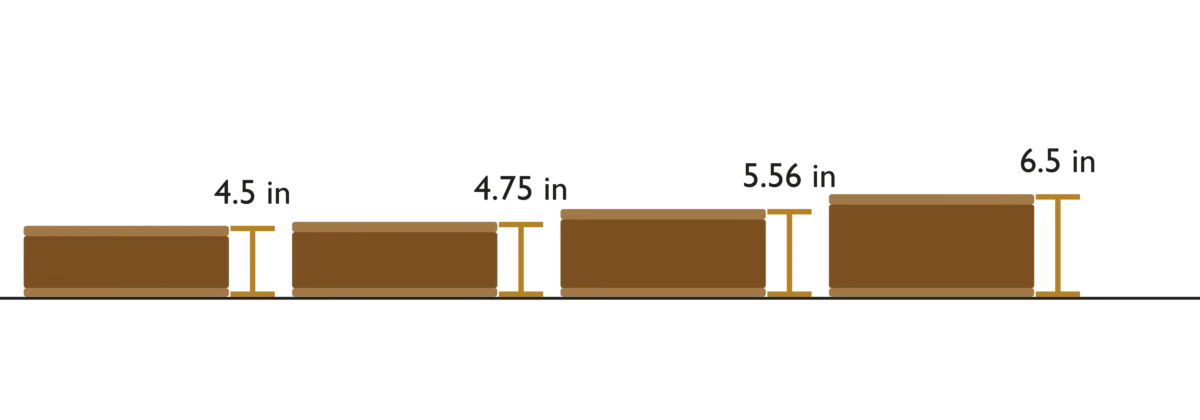
Kamps publishes about 4½ inches for a 48 × 40 stringer example; PalletOne publishes 4¾ inches in a GMA guide; Freightquote gives about 6½ inches as general guidance. These figures illustrate why “standard 48 × 40” is not a complete height specification.
Empty height is not loaded height
Loaded height = empty pallet height + carton layers + top caps or projections. If cartons are 10 inches high and you use five layers on a 5.6 inch pallet, the simple total is 55.6 inches before slip sheets, corner protection, a top cap, uneven cartons or wrap extending above the load.
Stack height is a separate calculation
For empty pallets, multiply the individual height only when the bases do not nest. Nestable plastic pallets can add a much smaller incremental height after the first pallet. Ask for the manufacturer’s nested stack height or nesting ratio.
For loaded pallets stacked one on another, total the actual loaded heights and check whether the lower load and pallet are approved for that condition. OSHA’s material-storage rules require stable stacking, but they do not establish one universal numeric maximum pallet-stack height.
How to measure pallet height
- Place the empty pallet on a level surface with no debris beneath it.
- Measure vertically from the floor to the highest point of the top deck.
- Check more than one corner if the pallet is worn, warped or repaired.
- Record whether the value is empty, loaded or nested-stack height.
- Use the actual pallet value in the load plan and receiving check.
Sources
- CHEP North America 48 × 40 block pallet.
- PECO specifications.
- EPAL 1 Euro pallet.
- CHEP UK wood pallet.
- Japan Pallet Association T11 history.
- CHEP Australia wood pallet.
- Kamps, PalletOne, and Freightquote for the labeled educational examples.
Checked November 14, 2026. Converted inches are rounded.
Check the full loaded height
Enter the measured empty pallet and packed-carton height.