A stringer pallet supports its deck on long parallel members. A block pallet uses separated blocks between the upper structure and lower boards. That structural difference changes entry paths, repair parts and bottom design—but not every performance rating.
Direct answer
Stringers create continuous supports; blocks create separated support points
A typical wood stringer pallet has three long stringers beneath the top deck. Solid stringers usually make it two-way; notches can add partial four-way forklift entry. A common block pallet uses nine blocks connected by deck boards, stringer boards and bottom boards, which can create true four-way openings.
Neither label proves that a pallet is stronger, rackable or suitable for a particular load. Those conclusions require the exact design, material, fasteners, condition, support span and manufacturer’s rating.
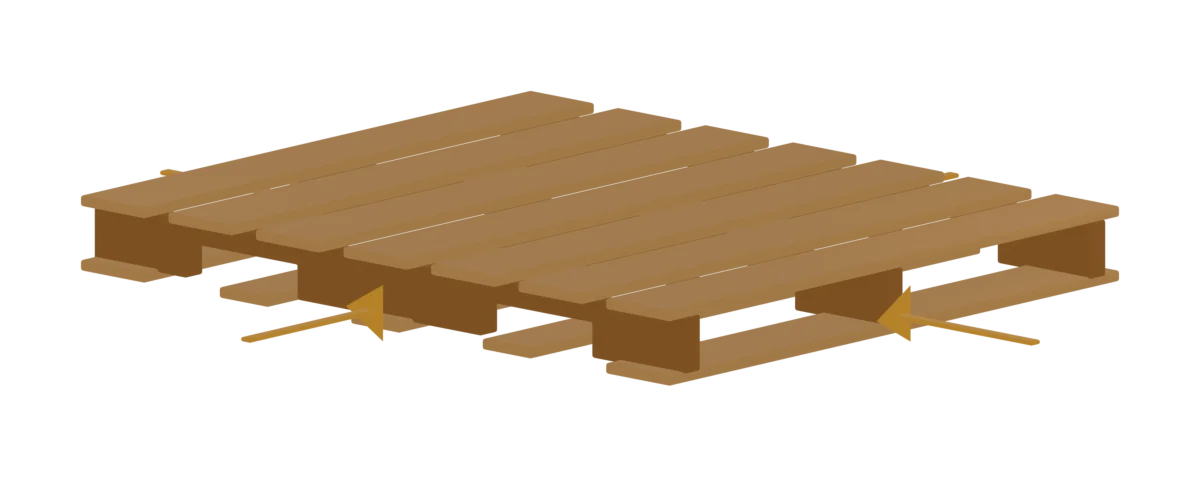
Stringer pallet
Deck boards fasten to continuous stringers. The notches shown add side fork access but do not remove the stringer from the pallet-jack wheel path.
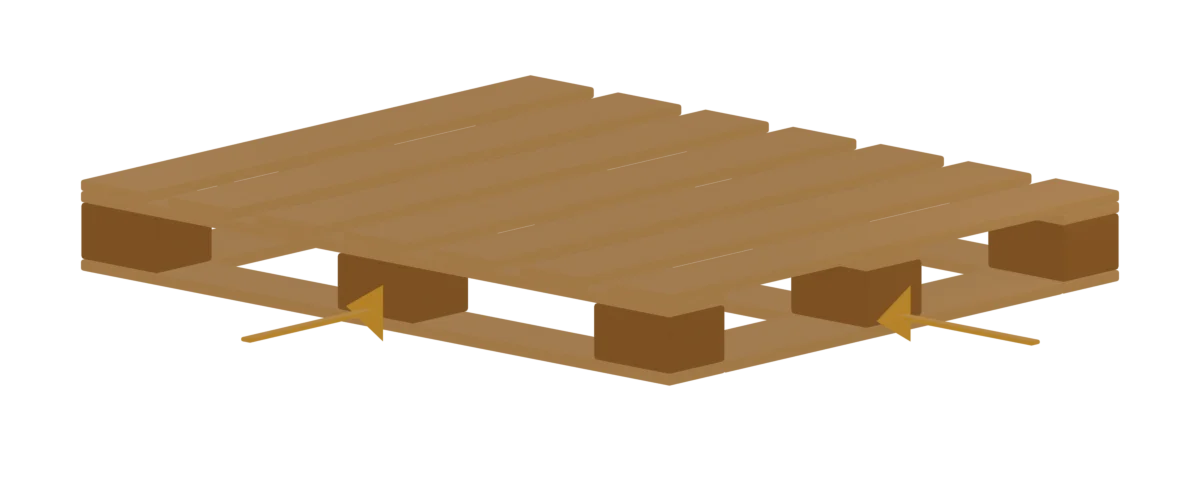
Block pallet
Separated blocks support the upper boards while lower boards tie the base together, leaving approach openings between support points.
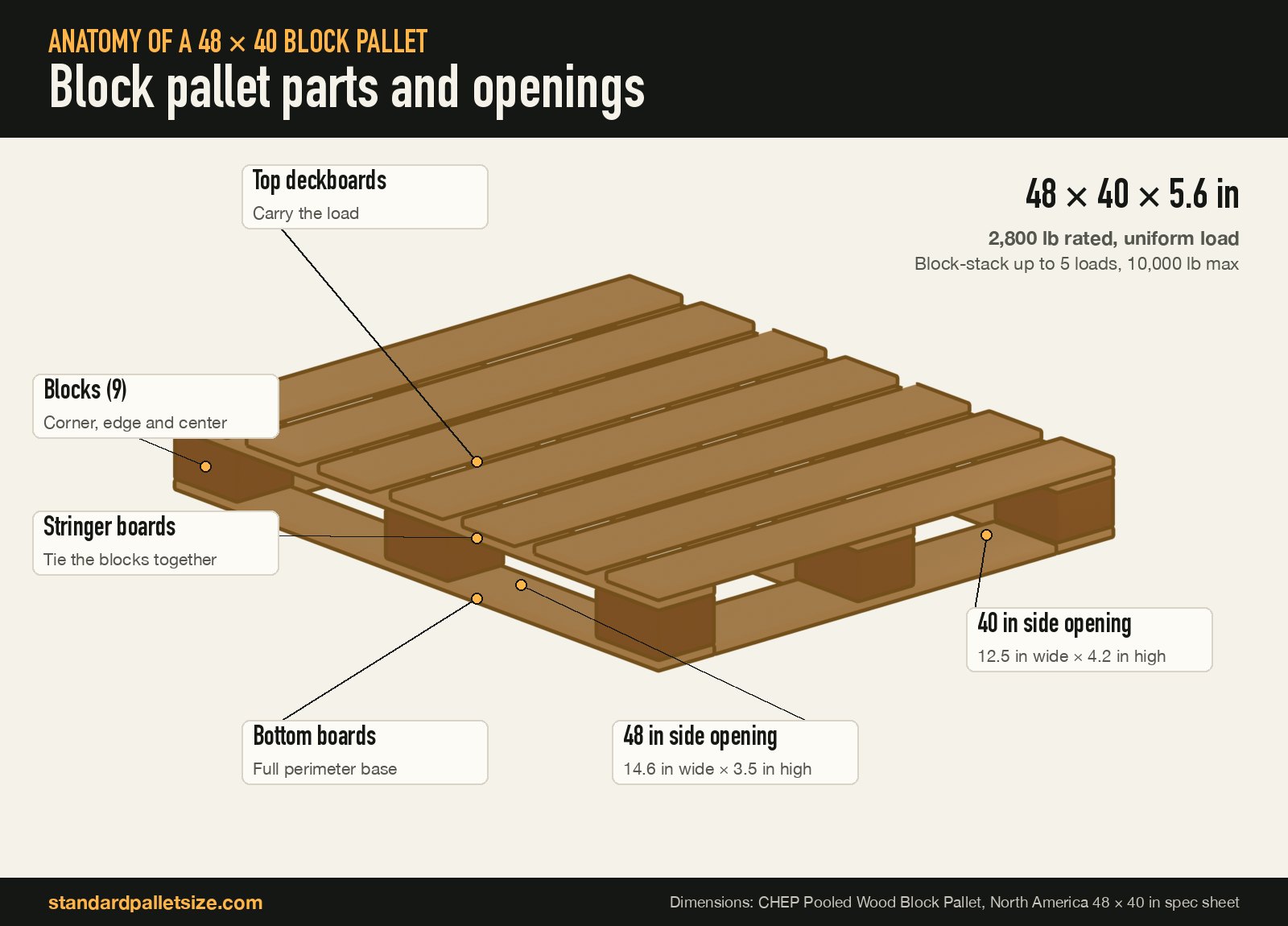
Matched models isolate the structural difference. They are illustrative builds, not certification drawings for every pallet sold under either name.Block pallet parts. Openings per CHEP’s 48 × 40 spec sheet.
Anatomy
How the load path is assembled
Stringer construction
Top deck boards sit across long stringers running in one direction. Bottom deck boards may join the stringers on a double-deck pallet. The stringers provide continuous longitudinal support and are often the parts cut or replaced during repair.
A solid stringer blocks crosswise entry. A notched stringer preserves most of the continuous member while cutting fork openings into its underside. That makes the structure partial four-way for lift trucks, not automatically free-entry for every pallet jack.
Block construction
Blocks sit at separated locations—commonly three rows of three in a nine-block layout. Upper deck boards and stringer boards form the load deck; bottom boards join the block rows and shape the base.
The spaces between blocks can allow forks to approach from all sides. The exact bottom pattern still matters: parallel bottom boards, a perimeter frame and other bases contact racks, conveyors and the pallet below in different ways.
Comparison ledger
Stringer and block pallet differences
Question
Stringer pallet
Block pallet
Primary supports
Long, continuous stringers
Separated blocks with upper and lower boards
Typical entry
Two-way with solid stringers; partial four-way when notched
Often true four-way, depending on base and opening geometry
Bottom
May use bottom deck boards across the stringers
Often uses stringer boards and bottom boards; some named designs use a perimeter base
Repair inventory
Stringers and deck boards
Blocks, stringer boards, deck boards and bottom boards
Handling advantage
Simple directional structure; notches can add side fork access
More approach directions when designed for full four-way entry
What the label does not prove
Load capacity, rack rating, tare weight, height, treatment, grade, ownership or acceptance by a receiver
Entry is a separate axis
Do not use “block” and “four-way” as synonyms
Structure and entry are related, but they are not the same label. A common nine-block pallet can be true four-way. A notched-stringer pallet can allow forklift forks from four sides. Both statements can be true while their pallet-jack access remains different.
Use the separate 2-way vs 4-way pallet guide to check the handling path, then use this structural comparison to discuss repair parts, base contact and load support.
Named examples
The same 48 × 40 footprint can use either structure
The common North American 48 × 40 inch footprint does not prescribe one construction. Traditional grocery-style pallets are often built with three notched stringers. CHEP describes its North American pooled 48 × 40 pallet as a wood block pallet with true four-way entry and a full-perimeter base. PECO also publishes a 48 × 40 block-class, double-face, non-reversible pool pallet.
These named examples show why footprint and structure must stay separate. They also show why a product rating belongs to a specific design: CHEP’s or PECO’s published conditions cannot be transferred to every unmarked 48 × 40 pallet.
Footprint
48 × 40 in can describe stringer or block construction
CHEP North America
Named block design · true four-way · full-perimeter base
PECO North America
Named block-class · double-face · non-reversible · full four-way
Selection checklist
Choose the rated design, not the category name
Start with the unit load. Record the load footprint, weight, support points and sensitivity to deck-board gaps.
List the support conditions. Floor, forks, pallet rack, conveyor and stacked storage place different demands on the base.
Confirm every entry path. Include pallet-jack wheels, not just forklift forks.
Specify the bottom. Bottom boards, runners and perimeter frames interact differently with racks and automation.
Request the exact rating. Keep the supplier’s conditions with the drawing and do not treat a category average as a guarantee.
Check ownership and repair rules. Pooled pallets can remain the pool operator’s property and may require authorized recovery.